We do not have the baptism for John.
But I think the photo of the little girl that Donna has ties the families together.
So this section is still on probation - I am making lots of assumptions.
Max's tree shows John Willis baptised Slaidburn 1797 - but I have not found it referenced elsewhere. That is not to say I doubt it, all the other info I have checked from that tree has been correct and he does give a date not just the year.
From Clapham Parish Register (Findmypast)
John Willis of this parish bachelor
and Nancy Horner of this parish spinster
married by banns
third day October 1826
by Jas Robinson Curate
both made their marks
witnesses Thos (Oldfield?)
Ellen Leech her mark
1841 census
Clapham with Newby
all born Yorkshire
John Willis 40 Ag Lab
Nancy 35
Bridget 12
Ellen 7
Isabella 5
Henry 3
William 3 months
Edward 35 (Fioller????) possible death MarQ 1847 Settle
I think Edward is John's brother, the one baptised as Edmund.
Bridget the daughter, named for John's mother.
I have used a tree on ancestry by Paul Dixon.
1851 Clapham
John Willis 53 pauper Ag lab born Ing
Nancy 46
Ellen 17
Henry 12
William 8
John 6
Thomas 4
apart from John, all born Clapham
described as a pauper but so were the other ag lab on this page
1861 Clapham
John Willis Wid. 63 Ag Lab born Easington
Isabella 34 Housekeeper born Clapham
John 16 Platelayers lab. born Clapham
John W Horner nephew 4 born Settle
Bridget Leech 22 visitor born Clapham
servant out of place
1871 Clapham
John Willis Wid. 73 Ag Lab born Ing
Alice Maudsley Wid. 51 servant born Cowside
Henry Kaley 53 lodger journeyman blacksmith
born Cheshire
Probate 1879
John Willis late of Clapham cattle dealer died 8 Aug 1879 to Thomas Willis of 23 Chester road Tuebrook near Liverpool, engineer the son. Effects under £800
(Donna I think the photo of the little girl is the daughter of Thomas, granddaughter of John Willis)
possible death reg. from freebmd site
MarQ 1861 Settle, Nancy Willis
SepQ 1879 Settle, John Willis age 81
children of John Willis and Nancy Horner baptised at Clapham
Ann Willis c. 6 May 1827
Bridget Willis c. 15 Mar 1829
Jane Willis c. 26 May 1831 bur. 4 May 1837 Clapham
Ellen Willis c.1833
Isabella Willis c. 21 May 1836
Henry Willis c. 21 Jun 1838
William Willis c. 16 May 1841
John Willis c. 20 May 1843 death JunQ 1843 Settle
John Willis c. 16 Jul 1844
Thomas Willis
..............................................................................................
Ann Willis born 1827
marriage on ancestry
Liverpool St Philip 21 Jan 1850
Charles Wells stonemason Laznean St, father William stonemason
Ann Willis Bold Place, father John farmer
both signed
witnesses Joseph Miles, Bridget Willis
1841Clapham
Restus? (near Turnerford)
William Dawson 55 ind
Isabella 40
Ann Willis 14 F. S
John Turner 70 Ag lab
1851 Liverpool
Charles Wells 30 stonemason born Latham
Ann 23 born Clapham
Bridget Willis 22 milliner dressmaker
wife's sister born Clapham
1861 Gloucester St, Griffin Hotel
Liverpool
Charles Wells 40 Licenced victualler
Ann 33
Bridget Willis 31 sister-in-law barmaid
Mary Ceekhall gen. ser.
probate 1868
Charles Wells late of Wilton Street, Liverpool victualler died 8 Sept 1868 to John Clayton of 25 Stark street Liverpool Publican effects under £200.
..................................................................................
Bridget Willis born 1829
1841 living in Clapham with her parents
1851 living in Liverpool with sister Ann
1861 living in Liverpool with sister Ann
1871 Liverpool, Mount Pleasant, Russell Street
Bertha Willis 41 Publican born Clapham
Henry Willis 33 Publican born Clapham
Mary Anne Alderson 20 servant born Clapham
probate 1874 Bridget otherwise Bertha Willis late of Berry-street Liverpool spinster died 23 May 1874 to John Willis of Clapham cattle dealer the father next of kin effects under £200
.....................................................................................
Ellen Willis born 1833
1841 living in Clapham with her parents
1851 living in Clapham with her parents
marriage on Ancestry
Everton St. Peter 27 Feb 1859
Robert Edwards 28 watchmaker 29 Field St, father Robert Coachman
Ellen Willis 25 112 Field St, father John Labourer
both signed
witnesses Charles Lowcock jun. Bridget Willis
1861 Liverpool 12 Limes St.
Robert Edwards 30 watchEnape? maker born Prescott
Ellen 27 born Clapham
John 1 born Liverpool
Martha 2m born Liverpool
possible death DecQ 1868 West Derby Ellen Edwards age 35
.......................................................................................
Isabella Willis born 1836
used MaryCooper43 tree on ancestry
1841 living in Clapham with her parents
1851 Liverpool 48 Dale St.
Isabella Willis 16 servant born Clapham
(to a Victuler)
1861living in Clapham with widowed father
marriage on findmypast Clapham
24 Oct 1861
John Johnson miner, groom Clapham father William labourer
Isabella Willis of age, father John labourer
both signed
unusually there are 5 witnesses - all signed not sure if I am reading them correctly
Mary Dean?, Tho Shelvey? Thomas Preston
John Story Dean, Mary Johnson
1871 Clapham
John Johnson 27 Ag lab born Wenning Bank
Isabella 35 born Clapham
Mary A 7
Thomas H 5
William 2
Matthew 2 months
Isabella Sarton 45 nurse born London
1881 Wray
Mill cottages
John Johnson 37 Coachman born Clapham
Isabella 45 " "
Mary A 17 dressmaker " "
Thomas H 15 silk dresser " "
William 11 " "
Matthew 10 " "
Isabella 7 born Yealand
Agnes Ellen 3 " "
John 7 months " "
1891 Hornby
John Johnson 49 coachman born Clapham
Isabella 55 " "
Thomas Henry 25 silk dresser " "
Agnes Ellen 13 born Yealand Conyers
John 10 born Lancaster
Frederick Walter 8 born Wray
John father, did 79 general lab. born Garstang
1901 Bolton le Sands
Hawkshead West Lodge
John Johnson 60 coachman born Clapham
Isabella 66 " "
William 31 silk dresser " "
Matthew 30 silk dresser " "
John 20 coachman born Lancaster
Agnes E 23 born Yealand Conyers
Isabella Hayes 27 day married born Yealand Conyers
1911 Bolton le Sands
West Lodge Hawkshead Bolton le Sands
John Johnson 68 coachman born Clapham
Isabella 74 " "
Agnes Ellen 33 born Yealand Conyers
Ellen Marion Hayes 9 granddad. born Skerton Lancaster
They had been married 49 years had 9 children 1 had died.
death reg.
DecQ 1919 Lancaster John Johnson age 76
DecQ 1926 Ulverstone Isabella Johnson age 90
................................................................................
Henry Willis born 1838
1841 living with parents in Clapham
1851 living with parents in Clapham
1861 Liverpool
25 Dale Street
Henry Willis age 22 born Clapham
one of 4 barmen at a licensed victualler
1871 living with his sister Bertha/Bridget
birth reg. JunQ 1838 Settle Henry Willis
death reg. DecQ 1876 West Derby Henry Willis age 39
..................................................................................
William Willis born 1841
birth MarQ 1841 Settle William Willis
1841 living with parents in Clapham
1851 living with parents in Clapham
1861 Liverpool, Mount Pleasant
50 Ranelagh? St
Henry Langsketh 29 Grocer born Bentham
Elizabeth 26 sister housekeeper born Bentham
Joseph Collins 20 boarder grocers app born Cumberland
William Willis 19 boarder grocers app born Clapham
Richard Foster 15 nephew grocer merchants app born Bentham
don"t know what happened to him after
.....................................................................................
birth JunQ 1843 Settle John Willis
death JunQ 1843 Settle John Willis
.....................................................................................
John Willis born 1844
birth JunQ 1844 Settle John Willis
death Mar Q 1919 West Derby John Willis age 78
wife's death JunQ West Derby Mary Willis age 64 (b. 1845)
1851 living with parents in Clapham
1861 living with father in Clapham
1871 West Derby
57 Romily St
John Willis 26 labourer born Clapham
Mary 27 born Kirkby
Annie 2 born Liverpool
Thomas Willis 24 brother born Clapham
Will Molyneaux 30 brother in law born Kirkby
Isabella " 27 sister in law born Cumberland
Mary Cressley 59 born Cumberland
marriage
Everton St Peter 22 Jan 1866
John Willis 22 labourer 23 Watmough St father John farmer
Mary Tyrer 22 " " father Henry farmer
both signed
witnesses James Leonard, Catherine Farrington
children of John Willis and Mary Tyrer
Annie Willis
Ellen Willis
Henry Willis
Margaret Nancy Willis
Henry Willis
Albert Willis
2 missing
1881 West Derby
37 Radcliffe St. Everton
John Willis 36 cab owner born Clapham
Mary 37 born Kirby
Annie 12 born Liverpool
Ellen 9 " "
Margaret 4 " "
Henry 2 " "
Samuel Cropper 42 lodger born Liverpool
Edmund Harper 26 lodger born Manchester
1891 West Derby
19 Cobden Street
John Willis 46 general labourer born Clapham
Mary 46 born Kirby
Nellie 19 cigarett maker born Liverpool
Marat 14 domestic nurse " "
Henry 12 " "
Albert 9 " "
Saml Cropper 52 boarder cotton porter (dock)
Andrew Rolands 37 " furniture remover
1901 Everton
19 Cobden Street
John Willes 56 cotton porter (dock) born Clapham
Mary 56 born Kirby
Henry 22 cotton porter (dock) born Liverpool
Albert 19 cotton porter (dock) " "
James Morgan 54 boarder printing compositor
Jane Chester 40 " born Liverpool
1911 19 Cobden Street
John Willis 67 porter (warehouse?) cotton born Clapham
married 44 years, 8 children born, 3 died
Margaret Hogben dau. mar. 8 years, 2 children born Liverpool
John Hogben 8 grandson " "
Ann Jane Brown 56 ?
Bessie Fitzsimons 58 ?
...............................................................................
Thomas Willis
Monday, 27 January 2020

Parish
Slaidburn
genuki Slaidburn has useful information about the parish.
In particular under maps the one showing parish boundaries is an old map showing the old names.
You can enlarge the view so it is possible to read the names.
Near the green number 280, there is the name Old Ing which might be relevant to John Willis eldest son of Henry. It is near Easington. Close by is Clapham Common and Austwick Common. So if the Willis family lived in this part when they married they were close to Clapham parish. If you scroll to the left you will find Botton Head which I think is where Nicholas Willis was in 1841. Further over to the left near the green number 133 is Over Wyresdale and just below it is Doe Holme the farm where John Remington and Isabella Leech lived, and where Richard and Isabella Slinger ended up.
Clapham
I am slowly slowly making my own transcript of the parish register from findmypast starting with baptisms 1748 - 82. It is in a clear hand and mostly notes residence. Gentry indicated by use of Mr. craftsmen noted, but farmers and agricultural labourers making up the majority no occupation. Some page corners bent hiding part of entries.
Again genuki Clapham has useful information about the parish. The parish boundaries old map shows the village of Clapham near the green number 276. Just to the left you can find Tewit Hall, where Nicholas was born, Green Close and three squares below Dubgarth where Ann was born.
For the Remingtons over to the left going towards Ingleton you can see Yarlsber where our Jane Remington lived with her daughter.
A modern map by googling Slaidburn farms is also useful. If you try Clapham farms it gives you a map of London Clapham. But you can move the Slaidburn round. Tewitt farm is signed twice, on one of them is a photo - do not know if it is the right building but it is stone.
There is a lovely photo of Dubgarth - google Dubgarth Harling (rootsweb website).
Sunday, 26 January 2020
Henry Willis
I am working from other peoples research, which I shall acknowledge. I do try to confirm records but it is not always possible to do so. Therefore I shall colour information that I have verified. I also want to note records it would be helpful to look at.
..........................................................
Henry Willis lived and died before the census and civil registration. We only have limited information to go on. We do not know where he came from.
This information on the Willis family came from Max's Tree which used to be online - I think from the Trewartha family.
Henry Willis married Slaidburn parish church 11Feb 1797
Bridget Turner
their children
John Willis christened Slaidburn 25 Dec 1797
Ellen Willis christened Slaidburn 29 Nov 1799
(I have not found these two in the indexes of Slaidburn on Ancestry)
Edmund Willis christened Clapham *
Henry Willis christened Clapham 8 Nov 1807 born 8 Oct 1807, Dubgarth
Ann Willis christened Clapham 5 Oct 1812 born 5 Sep 1812, Dubgarth
Isabella Willis christened Clapham 5 June 1814, Green Close
Nicholas Willis christened Clapham 17 Oct 1819, Tewit Hall, farmer
Joseph Willis christened Clapham 2 Oct 1821, Tewit Hall
.........................................................................................................
The images of the parish register of Clapham is on Findmypast.
Henry Willis of Clapham was buried there 29 Dec 1831 aged 24 (son)
Bridget Willis of Clapham buried 26 June 1833 age 55 (wife)
Henry Willis of Clapham buried 29 Jan 1834 age 78
Joseph Willis of Austwick buried 20 March 1834 age 86.
At this time I do not think this Joseph is related to Henry.
His death was in the Lancaster Gazette March 22 1834
On the 17th inst. at Austwick Mr Joseph Willis at the advanced age of 86, father of Mr. Willis, solicitor of this town.
None of our Willis's deaths were in the newspapers.
I do not think Henry left a will either.
Early wills for this area are at Lancashire Records Office in Preston.
There are two we should look at - both I do not think are our Willis.
For the above
WRW/L/R643/105 1 May 1834
Joseph Willis, Yeoman, Austwick
and probably from his family
WRW/L/R635/102 13 Apr 1811
Joseph Willis, Yeoman, Austwick
If Henry had made a will it would be there.
..................................................................................................
*I think this was a mistake, and should have been Edward.
Only the father noted as Henry.
Bridget's father was Edward, it could be that Henry's father was John. Bridget's oldest brother also called John.
Note the gap between Edmund/Edward and Henry 6 years.
This was the time of the Napoleonic wars. The country feared an invasion by Napoleon.
notesfrombywaters.co.uk mentions 1803 muster rolls of Austwick, and 1807 registers of electors in Clapham and Austwick.
If the age on the burial is correct Henry Willis would have been born about 1756.
There seems to be a big age gap between Henry and Bridget. (20 years)
..................................................................................................
The parish register for Slaidburn is at Lancashire record office.
But I did find Bishop Transcript marriages for Slaidburn on Findmypast.
Henry Willis of the parish of Slaidburn Husbandman
and Bridget Turner of the same parish Spinster
were married in this church by publication of Banns
this Eleventh day of Febuary in the year one thousand seven hundred and
ninty seven.
By me Joseph Bowman curate
Henry Willis
Bridget Turner - her mark
In the presence of
Henry Maudsley
Wm Slaiter
Wm Slaiter was witness to many of the marriages, so probably has no relevance.
Henry Willis could sign his name.
He was probably a tenant farmer (husbandman).
Bridget Turner was a local girl - we will look at her family later.
Her parents were Edward Turner and Ellen Heaton, and they had a large family from the look of it.
Speculation - the two names of the Willis children which do not appear in Bridget's immediate family are Ann and Nicholas so they might be Willis names.
Geography
By coincidence we went on the winter cumbrian mountain express by the railway touring company on Saturday. A steam hauled excursion over the picturesque Settle Carlisle line. We have done this tour many times and it never fails to deliver a memorable experience.
For myself, it is the route that is of the most interest because the whole day has me glued to the window. Nearly the whole way has some kind of significance in terms of family history. Not having a car this is the closest I get to some of the areas.
Part of the route passes east from Clitheroe to join the Settle line at Hellifield, then north through Settle. It is skirting the area the Willis family lived.
As the train pulls way east of Clitheroe the land slowly rises up and it becomes less inhabited with lonely stone farmhouses. The green of the valley contrasting to the harsher uplands. Even though it was only January lambs were gambling about the fields. I guess ours was the first steam train they had seen. Past Horton in Ribblesdale the landscape is true mountains and moorland. Today the cloud sat full square on the tops - grey dampness. I've seen this land graced with glorious blue skies and bright sunlight, I've ridden above the clouds sunken in the valleys, another time the land was blanketed in snow but perhaps today we experienced the more common conditions desolate wild muted colours. There were still many walkers wrapped up warm, around Ribbleshead.
A series of valleys separated by uplands runs west to east.
......................................................................................
mountains
valley - Bentham, Ingleton, Clapham (from Lancaster in the west to Settle in the east)
upland - Forest of Bowland - Slaidburn
valley - Clitheroe, Remington, Gisburn
.........................................................................................
Donna
Our American cousin Donna has very kindly contacted me, and told me such interesting things about our common ancestors. She has rekindled interest in this branch of the family. It is so nice to have someone to share the journey. So thank you, thank you so much Donna. Donna has some photos and letters that are of such interest.
Our common ancestors are Henry Willis and Bridget Turner. Their story begins in the parish of Slaidburn an area I know nothing about. The Remington line descends from Ann Willis their daughter, Donna's line from their son Nicholas Willis.
I will post as we go along, from the point of view of someone who knows nothing, because I know when I look back on this in a couple of months time I shall have forgotten my train of thought. Suggestions and corrections welcomed.
Wednesday, 6 January 2010
Margaret Alice Townley 1863
To put the limits on this research, I have not done any primary document searching other than census. The ideas expressed here could very well be wrong. I would welcome other researchers opinions or suggestions.
The search for this lady's life and connection to the Remington tree began with the 1881 census. My GGG grandparents John and Isabella Remington had a farm Castle O'Trim in Over Wyresdale and alongside their own children were two nieces, one of whom was Margaret Alice Townley age 18 Dairymaid and born in Ingleton.
I searched back and forward on the census, then used Lancashire parishes online to find the details of Margaret's marriage, and used Free BMD to build up an hypothosis for Margaret's family.
In 1871 Margaret J Townley age 8 born Ingleton was a nurse to Francis and Margaret Whalley.
Using the BMD index I would suggest that Margaret belongs with this family :
marriage June quarter 1860 Settle
Richard Parr Townley + Jane Remington
birth June quarter 1861 Settle
William Remington Townley
birth June quarter 1863 Settle
Margaret Alice Townley
death September quarter 1863 Settle
Jane Townley
so Margaret's mother died when she was a baby. Her father appears to have remarried
marriage September quarter 1864 Liverpool
Richard Parr Townley + Margaret Davies
The problem is that when Margaret Alice married 23 Sep 1884 (St. James, Stalmine, details online) to William Cross her father is named as Peter. It does not look like Margaret was illegitimate. Could it be possible that Margaret did not know who her father was? As it seems she lived with family members that would not seem probable, although they were families connected to her mother. Could it be that she did not want to acknowledge her real father? There is on the 1851 census a Peter Townley age 20 born Higher Wyersdale living in Barnacre? (Garstang Stalmine) . But I have been unable to follow this family any further in the census. Margaret Alice Cross's age matches and birthplace given as Ingleton. Perhaps it was just a mistake, Margaret signed her marriage with a X, and she was not local to the area so her family was not known to whoever married them.
In 1861 Richard P Townley 28, his wife Jane 29 and son William R. 1m were living at Scar End, Ingleton with Jane's family parents William Remington 54 and Agnes 59 and brother John 26.
Between 1861 and 1871, Jane died, Agnes (Jane's mother) died, and Richard remarried. As in another branch of my family after the death of a mother the young children were split up sons going to the fathers side and daughters to the mothers. Perhaps Richard's new wife did not want to fetch up her step children.
Anyway in 1865 William Remington (Margaret Alice's grandfather) married Jane Danson widow of Robert Danson who had been schoolmaster and postmaster in Ingleton. Her daughter also married in 1865 Margaret Danson to Francis Whaley - with whom Margaret Alice was living in 1871 helping with the young children.
In 1871 grandfather William Remington and Uncle John were still living up at Scar End.
Margaret's brother William Townley age 10 born Ingleton was living in Cockerham with his other grandparents Richard Townley 70 (born Higher Wyersdale) and Alice 81, and uncle James 31 born Caton.
Their father was living in Liverpool with his new in-laws.
Richard P Townley 36 born Garstang, with wife Margaret 30 and children Winifred, Ada and Richard.
In later census Richard's birthplace is given as Caton, and he has further children Thomas, John and Margaret Ann. He died before 1901.
And what of Margaret Alice's brother, could this be him? Did he change his middle name from Remington to Parr?
1891 William P Townley 27 groom born Ingelton married to Elizabeth living in Ramsbottom.
(September quarter 1890 William Parr Townley + Elizabeth Smith)
and in 1901
William Townley 38 carter on sewage works born Ingleton, with wife Elizabeth 31 and children Richard 9, Thomas 4 and William 10m.
(September quarter 1891 birth Richard Parr Townley).
.............................................................................................
You might be interested in where Margaret Alice Townley was born. Assuming the family were still at Scar End at that time, there are many photos online of the area about as it forms part of the famous Ingleton Waterfall walk. I was luck enough to do this walk a few years ago - and it was wonderful. The walk goes right past Scar End farm and you really do feel as though you are on top of the world. I cannot copy and paste with this computer unfortunately but if you do a google search for Scar End Ingleton -the site "The waterfalls walk from Ingleton village." mywainwrights.co.uk has a map as well as photos and the Scar End - Wikipedia has a lovely photo of the panoramic view.
.........................................................................................
One question that has niggled and niggled and is still unanswered, is how John Remington came to move to Over Wyresdale perhaps the link might have been through Richard Parr Townley's family. We only have the smallest glimpse of our ancestors lives, one day in ten years so many questions unanswered. Was Margaret Alice shown love as a child, or was she a painful reminder of her mother, or was she viewed as a nuisance. How long did she work as a dairy maid for uncle John? Did she get on with her cousins? The other niece that was visiting in 1881 Dorothy Ann was the same age, were they friends? After her marriage did she keep in touch with her family in Over Wyresdale?
So do you think I have it right about Margaret Alice? Or do you think I am assuming too much.
..........................................
I have received a lovely reply through Genes from Gregory. Thank you for your thoughts on this and you raised two important points that I had missed.
Gregory pointed out that "There is no evidence of two different Margaret Alice Townleys both born in Ingleton around 1863"
and "In the marriage record, Margaret Alice Townley is described as "spinster of Shirehead," which is a place in Wyresdale."
Thank you also to Clive, also replying through Genes - he agrees it is probably the same lady.
Friday, 21 September 2007
Letter from A. Borrow.
Well, first an apology for not posting on here for such a long time, real life has got in the way of my obsession. But that does not mean I have been idle, just not had the time to compose any new postings. I have had a busy summer but not totally with the Remington branch. I managed two trips over the summer, one to London to the British Library to look at a book and one to Ingleton to find Scar End farm. I shall post later about the Ingleton trip.
Margaret told me about this book : Valley of the Wild Stream: A History of Wildboarclough by Antony Borrow. It is where the information so kindly passed on by Sheila came from. I tried to borrow this book from Manchester library and was advised by them that there was a copy of the book available for reference at the British Library in London. Well, not one to be daunted I had to contrived to get there. Joseph could be persuaded with the prospect of a train trip and Cariad very kindly provided an extra reason by flying back from the USA after a choir trip and wanted to be 'met'. We stayed at the youth hostel, which was very convenient - opposite the British Library and close to three London main stations. However as usual things did not go smoothly. I had planned to spend a full day in the Library looking at this book but when we got there, and we were there for opening time, I was told under 18s could not go in the reading rooms. Disaster!!!! I had to rethink and re plan. You have to have a readers card to use the library so decided to get that and order the book for the following day - I must say I was not impressed with the British Library - I thought they were most unfriendly. I know they must get fed up with people who do not know the routine but it is quite overwhelming and different to other libraries. Firstly they appeared quite indignant that I was unaware of the rule about under 18s, then you have to go through a quite rigorous procedure to get your readers card- providing not just identification and proof of your address but also the reason you want to use the library, luckily I had the letter from Manchester Library. They then very 'kindly' issue you with a card with your photo on valid for a month. So if you go again you have to go through this all over again. Part way through this procedure their computers 'went down'......this was a good thing for me, people were turned away with the helpful advise that they did not know when they could register and the room emptied. As we were at a loose end this did not matter and the room became nice and quiet. You have to fill in your details on a computer and order books by computer. Not being very good on computers I found this difficult to do. Again I think the library could have made this easier. The actual building itself I did not like - big empty modern and soulless. A huge entrance hall, impressive but cold and empty and useless. I think it would have made more sense to have larger reading rooms. Mind you, I was probably being all negative because I was disappointed. Anyway we ended up spending the day walking about London and getting absolutely drenched. Joseph saw Waterloo, Kings Cross and St. Pancras stations so he was happy. The following day, I managed two hours in the library and Joseph stayed with Cariad.
There are two volumes to this book. They are hardback and about the size of a large old fashioned bible. I liked the look of them straight away and I think I was so excited I was shaking. Now I really did just glance through the pages and it was just the kind of book that I love. Not only does Mr. Borrow provide all his research details he also gives lots of background detail and tries to explain why things happened. He has an 'easy' (by that I mean enjoyable) to read writing style and the layout of the pages is good. I used the index to quickly look at the references to Remington. I have written to Mr. Borrow to ask him if I could quote from his book and I have received a lovely letter back. He has told me that there are other reference copies of his book at Macclesfield Library and in the library of the Cheshire Family History Society at Alderley Edge. So I am planning on going to Macclesfield at half term to have another more detailed look and check the notes I made in London. I will then posted them on here.
The general impression that I got from Mr. Borrow's book was that when William and Henry moved to Wildboarclough it was a time of investment and improvement in the valley but when the estate was inherited by the son he did not have the same attitude. So the fortunes of farmers not only depended on their own hard work but were subjected to the will of the landowners. Mr Borrow also wrote about agriculture in general and the difficulties faced.
There is a section in the book about Gamekeepers which is very interesting. I wonder how many gamekeepers there were in the valley at one time. There is reference to Henry in his capacity as gamekeeper being involved in the prosecution of a poacher.
Another interesting avenue of thought - both Remington brothers were involved in the Conservatives (? need to double check this, as I was running out of time and my notes by this time were a scribble - you are only allowed to use a pencil in the British Library). I had not thought about political leanings before.
To bring this post to a close a message to Mr. Borrow, if you manage to find your way here. Welcome and thank you once again for publishing such an inspirational book.
Monday, 30 April 2007
Kelly Directory : Macclesfield Forest
MACCLESFIELD FOREST is a township in the parish of Prestbury, 4 1/2 miles east-by-south from Macclesfield, in the Knutsford division of the county, petty sessional division of Prestbury, hundred, union, county court district, rural deanery and archdeaconry of Macclesfield and diocese of Chester. The township, which forms a part of the lofty chain of hills skirting the eastern verge of the county adjoining Derbyshire, is very bleak and mountainous and the land exceedingly unproductive. The Forest of Macclesfield, formerly an extensive demesne, was, like other royal forests, preserved for pleasure and recreation. The chapel, originally built in 1673 and rebuilt in 1834, is a plain edifice of stone consisting of nave and a small western tower containing one bell: there are sittings for about 150 persons. The register dates from the year 1759. The living is a perpetual curacy with Wildboarclough annexed, net yearly value £128, with residence, in the gift of the Earl of Derby, and held since 1901 by the Rev. John Trist Gasking, who resides at the Parsonage, Wildboarclough. Brough's charity of £1 12s. yearly is for distribution in money.
The township contains 3,499 acres, the property of the Earl of Derby K.G, G.C.B., P.C. who is lord of the mannor. The townships of Lyme, Hurdsfield, Kettleshulme. Rainow, Bollington, Pott Shrigley, Upton, Tytherington, Wincle, Macclesfield Forest, Sutton, Wildboarclough and Bosley, formed part of the Royal Forest of Macclesfield. The farms are small and widely scattered. "Shining Tor," 1,834 feet above the sea level and the highest point in Cheshire, is in this township. The population in 1901 was 172; area 3,499 acres; rateable value, £2,158.
Letters through Macclesfield; Wildboarclough, is the nearest post & telegraph office, 2 miles distant. Macclesfield is the nearest money order office.
National School (mixed) for 60 children; average attendance, 30; George Worthington, master.
(There follows a list of 33 names : interestingly Bottom-of-the-oven farm is in this township, it is the neighbouring farm to Broughs Place.)
Kellys Dierectory :Wildboarclough
The following is taken from Kellys Directory of Cheshire 1902 which can be found on the Internet at www.historicaldirectories.org.
WILDBOARCLOUGH is a township in the parish of Prestbury ecclesiastically annexed to Macclesfield Forest, 6 miles south-east from Macclesfield, the nearest railway station, in the Macclesfield division of the county, petty sessional division of Prestbury hundred, union and county court district of Macclesfield, in a bold mountainous district on the verge of the county adjoining Derbyshire and Staffordshire: a great part of the township is uninclosed moorland. There is a Mission room in the Clough, in which divine service is conducted once every Sunday by the vicar of the Forrest. Brough's charity of £1 12s. yearly is for distribution in money. Cragg Hall, the property of the Earl of Derby K.G., P.C., G.C.B. is a mansion of stone, beautifully situated and surrounded with pleasure grounds, but now (1902) unoccupied. "Shutlingslow," a bold peak 1,658 ft. above the sea level, is in this township, which also contains some quarries: in the valley is a fine trout stream. The township contains 5,021 acres of land and 19 of water, all the property of the Earl of Derby K.G., P.C., G.C.B. who is lord of the manor; the soil is sandy; subsoil, rocky. The land is chiefly pasture; the rateable value, £2,561; the population of the township in 1901 was 200.
By Local Government Board Order, ND. 22,378, a part of Wincle township was in 1888 transferred to Wildboarclough.
National School (mixed), erected in 1876, for 55 children; average attendance, 31; Edward Essex, master
Post, Telegraph & Express Delivery Office. - Mrs. EstberSeed, sub-postmistress. Letters through Macclesfield arrive at 10.30 a.m; dispatched at 1 p.m. The nearest money order office is at Wincle.
(30 names follow including Gasking Rev. John Trist (incumbent of Macclesfield Forest), The Parsonage : Remington Wm. Farmer, Dry Knoll: Wheelton Danl. frmr. Lower Nabbs)
Sunday, 29 April 2007
Musings.
This is just a posting about thoughts - so if you would rather just skip it that's OK with me. This morning Joseph and I went for a walk across to the old racecourse. Its only about 5 min from where we live but you have to negotiate a narrow 'tunnel' hemmed in on the left by an iron fence to keep locals out of the student accommodation, and on the right the River Irwell. Its a well used haunt of dog owners so you have to watch where you are putting your feet, and this morning was like walking through a cloud of midges. But when you emerge at the other end, out into the light you are faced with a great big open green, a precious emerald. I was hit anew with the sense of peace and quiet ( well relative quiet, as you could still hear the traffic droning away like the irritating buzzing of a wasp). I was thinking back to last weekend, wondering what life was like beyond the reach of the motor car. As a kid I spent much time rambling through woods and where we lived was a quiet backwater, car wise, but can't really appreciate just how much our lives are affected by the constant hum. I fear we shall loose this open space when the new student accommodation opens, sold off for housing no doubt. They are building on the other side of the river ugly modern thrown up monstrosities.
This led on to contemplation of another area of fascination for me at the present time. The Quakers. The search for inner silence is quite appealing. At the moment I am reading a book called "Quaker Annals of Preston and the Fylde" by Dilworth Abbatt. It was written in 1931 and is kept in the bowels of Manchester library - you have to fill in a paper slip hand it over to the librarian and then wait for it to come up in a 'dumb waiter' (I think that is the correct name for it). They then stamp the book, so you can see how many times it has been consulted before - there are only about a dozen stamps and the one before mine was in the 1960s, imagine that book has been sitting inside that building waiting 40 odd years for me to call it out into the light of day once more. How many other books are hiding down there in the gloom, forgotten unloved, what secrets do they hold. You are not allowed to borrow it and take it home. You have to sit in this awe inspiring room - round with a domed roof, but completely impractical for studying as every little sound is amplified and one hardly dares to breathe and disturb anyone else. The librarians seem quite immune to this and hardly whisper their conversations ! tut tut. I have spent three hours already on this book and I am still only on page 15.
This led on to contemplation of another area of fascination for me at the present time. The Quakers. The search for inner silence is quite appealing. At the moment I am reading a book called "Quaker Annals of Preston and the Fylde" by Dilworth Abbatt. It was written in 1931 and is kept in the bowels of Manchester library - you have to fill in a paper slip hand it over to the librarian and then wait for it to come up in a 'dumb waiter' (I think that is the correct name for it). They then stamp the book, so you can see how many times it has been consulted before - there are only about a dozen stamps and the one before mine was in the 1960s, imagine that book has been sitting inside that building waiting 40 odd years for me to call it out into the light of day once more. How many other books are hiding down there in the gloom, forgotten unloved, what secrets do they hold. You are not allowed to borrow it and take it home. You have to sit in this awe inspiring room - round with a domed roof, but completely impractical for studying as every little sound is amplified and one hardly dares to breathe and disturb anyone else. The librarians seem quite immune to this and hardly whisper their conversations ! tut tut. I have spent three hours already on this book and I am still only on page 15.
Saturday, 28 April 2007
The Remingtons at Wildboarclough.
Sometime between 1891 and 1901 William Robert, Isabella, HenryLeech and his wife Esther moved to Wildboarclough.
I would love to know the reason behind the move. Any suggestions would be most welcome. Perhaps William Robert got the offer of the gamekeeper job, I seem to remember reading that they preferred to employ 'non locals' as they would be less likely to turn a blindeye to locals poaching. It seems to me (at the moment) more probable that the area of Wildboarclough was an area in decline and the Earl of Derby wanted to encourage anyone to come into the area. I think the Earl had land in Lancashire, perhaps the offer of a job came through the Abbeystead estate. Perhaps there were no empty farms in Over Wyresdale or perhaps there was a sense of adventure. On the other hand moving about as farmers seemed to be quite common. As William Robert was unmarried perhaps Isabella went along to do the womans work on the farm and Henry Leech and Esther went along to help run the farm. Looking at the 1901 census they are not listed as visitors, I have looked at all the pages in their 'district' and there is one visitor noted so I think if they had just been visiting from Wyresdale that would have been written on the census. There are a few empty properties at that time including a farm. I also wonder how they learned the job of gamekeeping : did they just improvise as they went along? did the head gamekeeper or another gamekeeper show them the ropes? what did the work of a gamekeeper involve?
Anyway, sorry for rambling on, to return to the 1901 census the details are as follows :-
Wildboarclough, Dry knowl
Wm Remington Head 31 Gamekeeper Farmer born Yorks. Twislton
Isabel sister 23 born Wiradale
Henry L. brother 25 Farmer born Wiradale
Harriet s-in law 31 born Southport
Frederick Gardiner servant 15 Shep. born Wildboarclough
On ancestry they are mistranscribed as Rimington.
(Ref: RG13 piece 3315 folio 51 page 1 Macclesfield, Sutton District 11)
Rene told me that Esther was called Ettie.
Two marriages took place,
Jun 1904 Isabella Remington and Arthur Wheelton Lancaster 8e 1435
Arthur Wheelton was a local man from Wildboarclough in 1901 he was listed at his fathers farm Lower Nabbs.
Dec 1905 William Robert Remington and Isabella Annie Briscoe Settle 9a 15
The Over Wyresdale Remington family.
I am typing this at 00.15 because I cannot sleep and I did not get time today to sit at the computer. I have been trying to think of the best way to describe the various families on here in a clear fashion. I don't know about you but I easily get confused as to which person goes with which family and which William is which. So I am going to try colour coding and see how that goes.
Isabel sent me, via David the Remington tree which she has worked so hard on (although it arrived on A4 sheets which I am still trying to piece together). A big thank you to Isabel, I am not going to try and replicate it here but the information Isabel supplied has been used.
Get on with it Elizabeth, stop chattering on..............
So I will begin, not with the beginnings of the Remington family but with the family living in Over Wyresdale. I am going to colour this family green - I hope it shows up. I am also going to use capitals, yes I know it is frowned upon and regarded as shouting by some in the cyberworld but I want the names to stand out.
JOHN REMINGTON b. 1835
ISABELLA REMINGTON (nee LEECH) b. 1843
children:
-WILLIAM ROBERT REMINGTON b. 1867
-JOHN REMINGTON b. 1868
-RICHARD SLINGER REMINGTON b. 1870
-ANNE AGNES REMINGTON b. 1873
-HENRY LEECH REMINGTON b. 1875
-ISABELLA REMINGTON b. 1877
-BEATRICE MARY REMINGTON b. 1880
-THOMAS REMINGTON b. 1882
Using information from the census returns John Remington and his family moved to Over Wyresdale sometime between 1871 and 1873.
In the 1891 census the whole family was living at Dowholme farm. The details are:-
John Remington 52 farmer born Ellel
Isabella 49 born Yorks. Clapham
William Robert 24 farmers son born Ingleton
John 22 Estate Labourer Ingleton
Richard Slinger 20 Estate Labourer Ingleton
Ann Agnes 17 Farmers Daughter Over Wyresdale
Henry 15 Farmers Son Over Wyresdale
Isabella 13 scholar Over Wyresdale
Beatrice Mary 11 scholar Over Wyresdale
Thomas 9 scholar Over Wyresdale
Richard Slinger 72 visitor retired Clitheroe
Isabella 77 aunt Yorks. Clapham
(Census ref: RG12 piece 3462 folio 13 page 6, Lancaster, Ellel district 2)
But by the next census in 1901 the family had split up.
Three marriages had taken place :
Sep 1896 Lancaster 8e 1447 John Remington + Hannah Mason
(Lancaster Friends Meeting House, Preston AP49/1/68)
Jun 1899 Lancaster 8e 1441 Ann Agnes Remington + John Taylor
Sep 1899 Lancaster 8e 1537 Henry Leech Remington + Esther Wilcockson Dilworth
References are GRO index taken from the freeBMD site, the month refers to the quarter within which the marriage was registered.
William Robert, Henry and Isabella had moved to Wildboarclough. Along with Henry's wife Esther.
Richard Slinger was living on the Abbeystead estate where he worked.
Ann Agnes was living in Lancaster with her husband.
John and Hannah were living on another farm in Wyresdale with their two little ones ; Ruth and Isabella.
Beatrice Mary and Thomas were still living at home on Dowholme with parents John and Isabella.
Thursday, 26 April 2007
Sheila's information.
I have typed up the information as passed on by Sheila. The first part has words missing from the copy but does not directly refer to the Remingtons but have tried to include it as it relates to Broughs and also refers to Wheelton.
*************************************************************
The Billinges were therefore connected.................to Broughs for over fifty years. There were other members of the family ............................Wildboarclough. To summarise.
William Billinge was...................................He married the girl next door.................farmed Broughs and Wilsher with some land from...........probably from the date of his marriage. The couple had eight children, who may all have been born at Broughs. William died in 1840. His widow remained at Broughs, but Wilsher and the land from Cuckoo Rocks passed to her husband's brothers. About 1847 Alice remarried, to John Boothby, by whom she had one daughter. The couple continued to farm Broughs until the death of Alice's father, John Barlow, some time between 1851 and 1861; they then moved to the larger Dry Knowl and handed Broughs over to Alice's son Thomas and his wife Sarah Hannah formerly Wheelton. Thomas also farmed the lands of Wilsher, the house of which was empty from at least 1861. Thomas remained at Broughs until at least 1871, but by 1881 he had been replaced by his brother William, who farmed there until he died in 1890. His wife Maria died in 1892.
Remington.
The next record found relating to Broughs is in the Township Minutes, which record that Henry Leech Remington, of Broughs Place, was elected Overseer in 1907. His name recurs in this connection in 1908, 1909 and 1910. There is no other mention of Broughs between 1890 and 1907; but Henry Leech Remington can be placed in Wildboarclough (and therefore presumably at Broughs) in the Wildboarclough Register. Baptisms are recorded of children of Henry Leech and Esther Wilcockson Remington as follows: Henry Leech in 1901, Thomas in 1904, Richard Slinger in 1907 (who only lived 5 days), and finally Richard in 1909. This Richard had the distinction of being the first child to be baptised in the new church of St. Saviours.
A William Remington is listed in Kelly's Directory for 1902 as farmer at Dry Knowl. By 1906 William was listed at The Cottage, gamekeeper to the Earl of Derby. He is also listed at the Cottage in 1910, and Harry at Broughs.
In 1914 Kelly's Directory listed John Trelfa at Broughs.
The information also included two maps :- Tenancies at 1844 Sale and Tenancies at 1848 Tithe Apportionment. These show the fields of Broughsplace.
**************************************************************
Other information passed on through Margaret.
Henry Leech Remington, gamekeeper, lived at Broughsplace. He had a sale on 24th March 1911 contents were:
1 sheep, 13 cattle, 3 horses, 28 poultry, 3.5 in wheel cart, mowing machine, horse rake, spring trap, cart gears, cake crusher, chaff cutter, churn, usual farm tools.
William Robert Remington, gamekeeper, lived at Crag Cottage in 1908 but previously lived at Bleak Knowl and Dry Knowl where he had a sale on 24th March 1904. He sold:
2 sheep, 30 cattle, horse, 40 poultry, 2.5 in wheel cart, 1 horse mower, horse rake, gears, cheese presses, vats and tins.
Wednesday, 25 April 2007
Wildboarclough : Grahams pictures.
A very big thank you to Graham. He has sent us a picture of St Saviour Church in Wildboarclough. It has reminded me how important photos are - I think I said two steep stone steps out of this church onto the lane, as you can see below it was a flight of steps. The two steep ones that I was remembering now comes to mind as being at the car park at St Stephens.

Graham took the photo below on a previous visit to Wildboarclough. It shows the derelict Bleak knoll in the distance.

Graham took the photo below on a previous visit to Wildboarclough. It shows the derelict Bleak knoll in the distance.
I have also noted the corrections pointed out by Margaret and Graham - thank you.
A few notes on using this blog.
If you click on a picture you can make it larger.
If you want to leave a comment, question, answer to a question, or more information please click on the comment link at the bottom of an entry. These will not immediately show up as they have to be checked. I cannot promise to look at the blog every day, but will check at least once a week. It looks like you have to register to use the comment box. Alternatively you can email me.
The Steele-Golborne reference at the bottom, refers to my other blog - also a family history.
Thanks.
Tuesday, 24 April 2007
Wildboarclough part 4.
After lunch Graham and Margaret took us to visit Torgate farm where we met two lovely people - John and Sheila. Their son has made a dvd of the surrounding area and Sheila has researched the Remingtons for Joyce in a book she has access to. Valley of the wild stream. A history of Wildboarclough by Antony Borrow. I shall be posting details later.
Their farm is right up on the tops with inspirational views. I think if I lived there I would be permanently stood at the windows. They told us what it is like in winter when they are cut off by snowfall and how difficult it can be for the animals. The interesting conversation ranged from trail bikes, and their use on farms, to pictures hanging on the wall - some of which Sheila had painted herself, to talk of the Shows and Derbyshire Gritstone sheep. John actually judges these.
For the interest of 'townies' like myself, I found the following through Google :- Winter Hill Scrapbook by Dave Lane.
When most people think of a sheep, they think of … well …. a sheep!
They all look the same don't they? Actually no they don't - and there are
hundreds of different types of sheep in the fields, on the hills and
mountains of the British Isles. Different varieties of sheep are grown for
different purposes (some for meat, some for wool, others for breeding)
and some types fare better in different environments.
Sheep are both a blessing and a curse on Winter Hill. They are a blessing
because they look nice, they sound nice, they eat what's left of my butties
to save me taking them home and most importantly, they provide a
livelihood for local farmers. They are a curse because they seem to eat
everything and the Hill looks as it does now, mainly because of the sheep.
Unless an area is fenced off, no trees or shrubs grow, they are quickly
devoured. Where sheep are present, the vegetation is usually very short
and certain plant species are unable to survive the continuous close
grazing. The presence of sheep maintains the generally deforested top of
Winter Hill.
There are three main varieties of sheep grazing on Winter Hill.
"Derbyshire Gritstone", a mountain and hill variety which is found
mainly in Derbyshire and the Pennine Districts of Lancashire &
Yorkshire with a few also found in Wales. They are distinguished by their
faces and legs being white with black markings and there is no wool
growing on these parts either. They are hornless. Their wool is one of the
finest of all grown by the blackfaced type of sheep and it is extensively
used in the high quality hosiery business.
Page 10
Also seen on the Hill is the Swaledale, dark upper face with grey muzzle
and a tuft of wool on the forehead. Both sexes are horned. It is found in
the fells, moorlands and high ground of the six counties of Northern
England and it lives easily in exposed places.
Many Swaledale ewes are used for breeding the very popular Mules, and
the finer quality wool from this breed of sheep (the Swaledales that is!) is
used for the manufacture of tweeds, rug wool and some of the thicker
hand-knitting wools. Much of the wool is of coarse quality but this is
ideal for the making of carpets.
The final variety found on the Hill is the Cheviot.
Page 11
The Cheviot is distinguishable by its erect ears, white face and legs with a
ruff of wool behind the ears. There is no wool on the face or legs below
the knee or hock. The males are occasionally horned. The wool quality
varies from fairly course to quite fine and is used for manufacture into
clothing - ranging from rugged sportswear to lighter town suitings.
Cheviot wool is also used for making blankets, rugs and hosiery yarns.
You need never again wonder what type the sheep are on Winter Hill!
However, just to confuse you, the breeds listed are only those you will
find on the Hill itself - in the fields on the lower flanks of the Hill you
will also find Mules, Dalesbred and Lonks plus a few other crossbreed
varieties.
Dalesbred - distinguishable by its black face with distinct white mark at either side of
its nostrils. The legs are also black and white and they have a rounded low set pair of
horns. The fleece is tough and springy and is ideal for making carpet yarns.
Dalesbred can survive in the bleakest conditions and on the roughest pastures.
The sheep on the upper parts of the hill are free to roam and are brought
back down the hill several times a year for mating (known as "tupping")
usually around October/early November, lambing around April and for
clipping in June/July. They may also be brought off the hill for dipping
and worming although some farms dip the flock at clipping time, whilst
others delay the dipping for a month or so until a little fleece has re-
grown.
They also showed us a stick. You see I always think of questions to ask afterwards. I think I was so overwhelmed by excitement my brain was addled. So I shall ask them here and if any kind person can enlighten me I would be very grateful.
Where do they get the wood from to make these sticks?
How do they get that deep rich warm colour?
How do they get them so smooth?
All too soon it was time to head back for home. Graham drove us back along the valley and into Wincle parish where we saw another chapel/school which has become a private residence before heading for Macclesfield.
The conversations on the way included Joseph asking questions about how the Common Agricultural Policy affects farming something he is studying at school for geography.
All in all what a brilliant day. Going to the area the Remingtons lived in gives me a much clearer understanding of their lives, something I could not get from just researching documents. However it has also thrown up loads more questions.
Monday, 23 April 2007
Wildboarclough part 3.
After St. Stephens we descended back down into the valley, passing some very energetic cyclists coming uphill. Graham stopped halfway down so we could get a good view of the two farms where the Remingtons lived. (This is where the bottom two photos were taken). We then carried on to Wildboarclough following the valley road. This road follows Clough Brook which trips and tumbles along. It looked very picturesque and quite charming but one could sense the hidden strength of this stream. At Wildboarclough itself there was a carpet mill at one time which harnessed the power of this stream, and also there, it is contained by deep stone walls. As we passed up the valley we saw many brightly coloured cock pheasants but fewer hen pheasants.
Now many apologies here because I failed to take pictures at Wildboarclough itself and the few I did take of the church did not come out (- very indicative of my skills with a camera). So I am afraid you will have to rely on a description. (See Grahams picture in a later post). As you drive along the valley there is an increase in the number of trees and when you reach the village, with a turn off to the left it feels much more closed in and 'dark'. There is a row of terraced cottages on the bottom road with arch style windows. Taking the road off to the left you climb out of the bottom passing several stone houses on the left, a red phone box, a three storey impressive residence behind gates named 'The post office' and then the church set back from the road. This is where we parked.
There is a photo of the old post office along with other views around the valley as well as information about Wildboarclough and Macclesfield Forrest on this site :- http://www.cressbrook.co.uk/scripts/towns/villages.php?placename=Macclesfield&topX=3930&topY=3760&bottomX=3890&bottomY=3720&map=tile7&dist=8This
According to one of my favourite sites - Genuki, St Saviour was founded in 1873 as a chapel to St. Stephen and became a parish church in 1906. Margaret and Graham told me that there was a delay from the first stone for the new church being laid to the completion of the building because of a dispute. Richard Remington is the first baby to be baptised here. The church is very pretty, it is a reddish colour. It has little gable windows in the roof and a friendly ambiance. But personally I think I preferred the wildness and openness of St. Stephens. The overall impression of Wildboarclough was dark green. Whilst there we were treated to the aroma of freshly cut grass as a lady was mowing the church grounds, a very skilled and intricate job given the steep slopes and gravestones to negotiate.
We walked down the hill, leaving the church via two steep and narrow stone steps (see correction in Grahams picture in a later post). Retracing our steps we followed the brook on the other side of the lane. There was an old iron gate in the wall and a single stone slab bridging the 'chasm' - they must have had no fear crossing that as it wasn't very wide. I later wondered if this led to Crag cottage.
Continuing our journey we climbed out of the bottom, turning left again passed Crag Hall to follow the high road back along the valley towards Dryknowle farm. We parked up part way along to have our sandwiches. So you can image us eating our lunch with the view below. Drinking in the fresh air. This is Shutlingsloe the highest peak in Cheshire and we could make out some successful people who had made it to the top - comment by me "Are there trees up there?", then they moved. Another interesting sighting was two mallard ducks waddling across the field below us.

The view below shows the lane going up to Dryknowle farm - in the trees.

This is Broughsplace.

Now many apologies here because I failed to take pictures at Wildboarclough itself and the few I did take of the church did not come out (- very indicative of my skills with a camera). So I am afraid you will have to rely on a description. (See Grahams picture in a later post). As you drive along the valley there is an increase in the number of trees and when you reach the village, with a turn off to the left it feels much more closed in and 'dark'. There is a row of terraced cottages on the bottom road with arch style windows. Taking the road off to the left you climb out of the bottom passing several stone houses on the left, a red phone box, a three storey impressive residence behind gates named 'The post office' and then the church set back from the road. This is where we parked.
There is a photo of the old post office along with other views around the valley as well as information about Wildboarclough and Macclesfield Forrest on this site :- http://www.cressbrook.co.uk/scripts/towns/villages.php?placename=Macclesfield&topX=3930&topY=3760&bottomX=3890&bottomY=3720&map=tile7&dist=8This
According to one of my favourite sites - Genuki, St Saviour was founded in 1873 as a chapel to St. Stephen and became a parish church in 1906. Margaret and Graham told me that there was a delay from the first stone for the new church being laid to the completion of the building because of a dispute. Richard Remington is the first baby to be baptised here. The church is very pretty, it is a reddish colour. It has little gable windows in the roof and a friendly ambiance. But personally I think I preferred the wildness and openness of St. Stephens. The overall impression of Wildboarclough was dark green. Whilst there we were treated to the aroma of freshly cut grass as a lady was mowing the church grounds, a very skilled and intricate job given the steep slopes and gravestones to negotiate.
We walked down the hill, leaving the church via two steep and narrow stone steps (see correction in Grahams picture in a later post). Retracing our steps we followed the brook on the other side of the lane. There was an old iron gate in the wall and a single stone slab bridging the 'chasm' - they must have had no fear crossing that as it wasn't very wide. I later wondered if this led to Crag cottage.
Continuing our journey we climbed out of the bottom, turning left again passed Crag Hall to follow the high road back along the valley towards Dryknowle farm. We parked up part way along to have our sandwiches. So you can image us eating our lunch with the view below. Drinking in the fresh air. This is Shutlingsloe the highest peak in Cheshire and we could make out some successful people who had made it to the top - comment by me "Are there trees up there?", then they moved. Another interesting sighting was two mallard ducks waddling across the field below us.
The view below shows the lane going up to Dryknowle farm - in the trees.
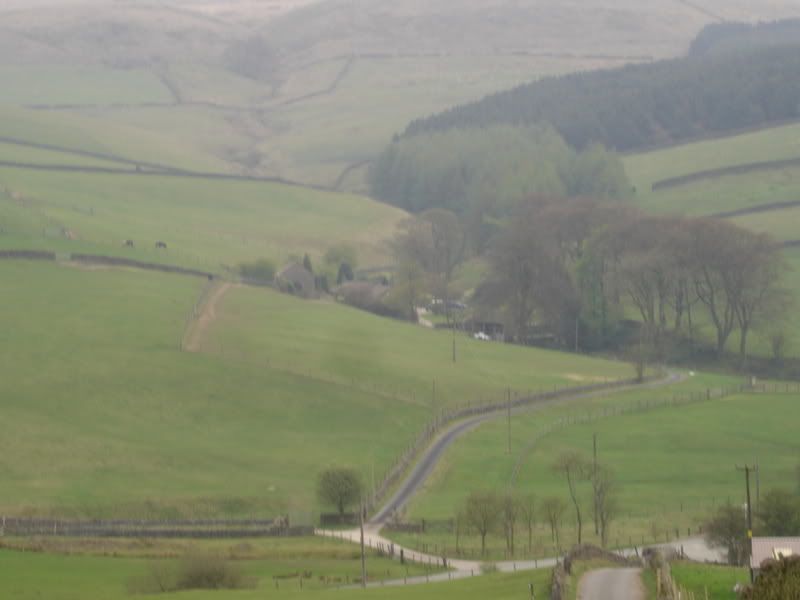
This is Broughsplace.
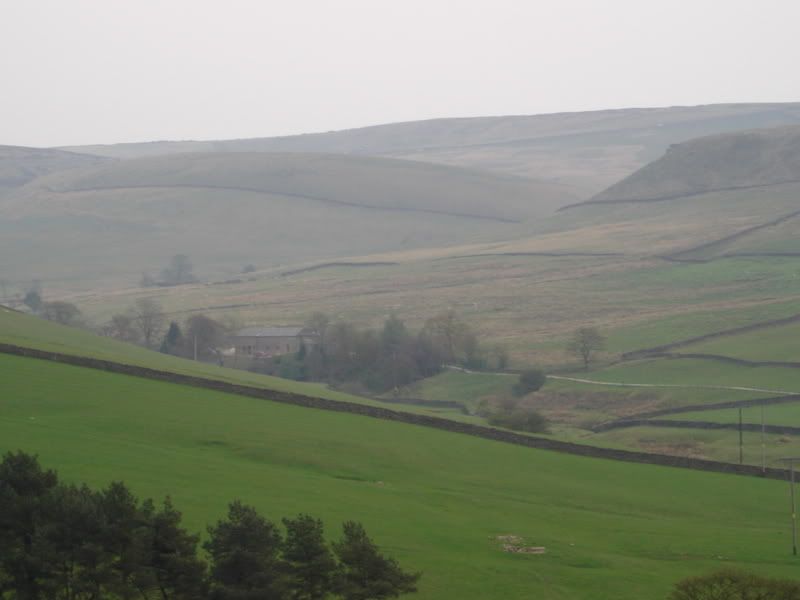
Sunday, 22 April 2007
Wildboarclough part 2.
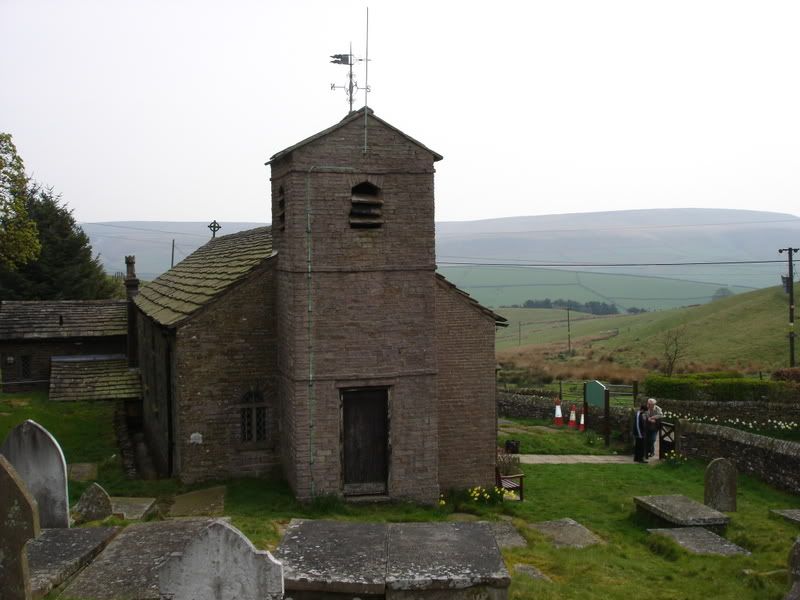 This is a view from the top end of the Chapel. Breathtaking.
The school is to the right. I wonder if you are surrounded by such beauty would you ever want to leave. Well its a good job I went with Margaret and Graham. Margaret fetched me down to earth by talking about the realities of living in such a place. Its all very well seeing this through the rose tinted spectacles of a "townie" on a fine clear day. In the early 1900s it would have felt even more remote and isolated.
 This sycamore tree grows behind the chapel. Margaret saw a hole in the trunk which we went to investigate, it turned out to be quite large.
 This is the school across the lane from the Chapel.
On the National Archives site there is reference to a Wildboarclough Crag National School which was built in 1876. It was a primary school until it was reorganised in 1969 when junior pupils were transferred to Wincle. But further up the valley at the village of Wildboarclough is St Saviour Church where the books inside, are inscribed with Crag Church. There is also Crag Hall near that church.
I wonder how many children attended this school? And if when they played outside they were as noisy as children in the school playground today? Although it felt like we were miles from anywhere we walked past the car in the picture and round the bend to look over towards Macclesfield Forrest and were studying the map when some friendly walkers stopped to pass the time of day. A couple of them lived in Marple - small world.
Margaret remembers her dad talking about the long walk to school.
See later posting about schools - I now think this may have been Macclesfield Forrest School.
Wildboarclough. Part 1.
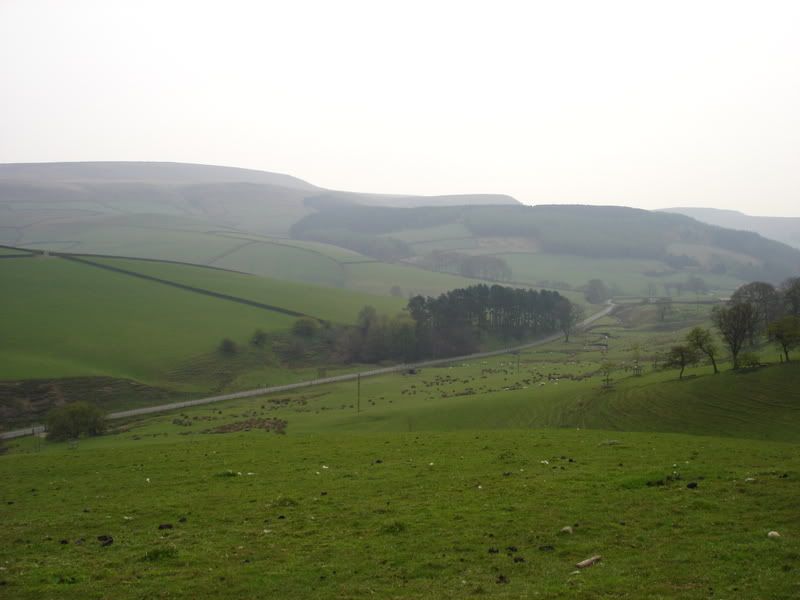 Yesterday two very special people did something wonderful for me. Margaret and Graham I would just like to say what lovely people you are and I am so glad that we met yesterday. This blog owes it existence to you and the 21st of April 2007 will always remain as a special memory.
Being without a car I am limited to travelling where public transport provides a service. Margaret and Graham met myself, and dear son Joseph, at Marple station and took us to see Wildboarclough where some of the Remington family lived at the beginning of the 20th century. Here follows an account of this fantastic day.
Having listened to the favourable weather forcast the night before we dressed accordingly in lightweight clothes - fine and warm with temperatures up to 20C. Being a "townie" I took little experience of the hills with me. Up bright and early, excitment bubbling away I couldn't wait to get off. It was remeniscent of faroff days the night before christmas, but with the added knowledge that I was going to get the present I had so longed for....We had a good outward journey to Marple, Joseph liking the fact we had the train to ourselves and it was not a railbus. And waiting on Marple station we saw a freight train pass and watched our train negotiate the points.
Graham and Margaret were early picking us up and put both myself and Joseph at ease straight away. Bags were swiftly stowed away and we were off. They gave us an interesting commentry about the places we were passing through which was very helpful as it was all new territory. (Although if you asked me today to direct you I probably wouldn't be much help.) Amongst the places of interest pointed out was Poynton sports hall where Graham plays table tennis. In no time at all we were climbing up out of Macclesfield leaving the Cheshire plain behind. I minded not one little bit that it was not a clear view because the sky was hazy. It wasn't raining and that was all I was bothered about.
We turned off the road leading to Wildboarclough to begin the climb up to Chapel House farm and Graham stopped the car for us to get our bearings. I had bought an Ordnance Survey Map (OL24) and the locations I shall give refer to this (so I can remind myself where the photos were taken). As we stepped from the car the fresh Cheshire air met us. And the silence. Bliss.........You have to remember I live in a terrace, in the inner city with a main road at the end of the street with not much opportunity to connect with nature.
This is where the picture above was taken. (In a line more or less with Bottom-of-the-oven) The hill in the forground to the left is Torgate Hill behind which is hiding Broughsplace. Following the road along the valley you can just make out the crossroads where the turnoff for Dryknowle farm and Broughsplace is to the left.
Then it was back into the car to continue the ascent to Chapel House farm. Mum you would love to drive up these narrow lanes with steep drops to oneside! I was alright, on the side away from the drop. We parked outside the little chapel, which nestled amid a small hamlet. The photo above is the old horse trough fed by a natural spring and full of frogspawn with some hatched tadpoles darting about the bottom. Margaret was a hive of nature information all day, which was lovely. Amongst other things she pointed out the delicate spring flowers - primroses, forget-me-nots, bluebells, explained the browny long grass where the sheep were not eating would be boggy ground, talked of the damage little "cute" moles do (and how at one time mole skin trousers were in vogue), identified creatures burrows and pointed out a field of goats.


On the map it is beside Chapel House farm. Set high above the valley, yet it did not feel a lonely place. It is the closest Church to Dryknowle and Broughsplace but we have no way of knowing if this was the church they used. The school the young Remingtons attended stands just across the lane and it was certainly a trek up hill and down. Margaret told us of her own experiences of walking to school in the winter after heavy snowfalls, the height of the walls. The following notes were taken from the leaflet obtained from inside the Church. The chapel we see today was built in 1834 and is a very plain and simple style in complete contrast to large parish churches. There is an original stone from the first chapel dated 1673. Every year, on the first Sunday after 12th August, Forest Chapel holds its rushbearing service. At this Chapel it has been going on as long as anyone now living can remember. (It would be nice to think that the Remingtons of Wildboarclough attended these ceremonies.) The chapel is decorated with plaited rushes, cut in a local marshy spot, which are interwoven with flowers; rushes are also strewn on the floor. The service begins in the church at 3pm, and is relayed outside by loudspeakers. Up to 600 people attend the service, so there is not room for them all inside the building. Margaret also told us of the time they set out to go to this Rushbearing from Glossop but when they got to the station there were no trains!
Inside the chapel it was bright and airey. Welcoming and friendly. The roof underside was wooden and the walls white. Margaret noted the workmanship which had gone into prayer cushions made in 2000 and bearing designs in cross stitch. I was busy absorbing the atmosphere and wondered how full it would have been in days gone past, and what a delightful place it seemed to worship the Lord. In the book of visitors one person had lamented the removal of a swallows nest.
Introduction.
Hello.
My name is Elizabeth and this blog is going to be about the search for an understanding of the lives of the Remington family. It is a work in progress.
I am obsessed with family history. Why?
"It seems that without the reasurance of a sense of belonging, many people feel anxious and insecure."
My passion has grown to an interest in everyone and everything ordinary. I am often led astray from my original questions. I am very disorganised and there is no structure to my research so this will (I know) end up as a piecemeal collection of interests some of which will only have a very loose connection to the Remington theme.
Why a blog?
Well I am always loosing things. This will force me to focus. I am always full of good intentions which somehow I never get around to. And this is a good way for other members of the family to see what I have been up to. Also having suffered from a complete computer crash - storing things on here I hope will keep them safer.
An invitation.
This is not just my work. Please get in touch if you have any comments or information to put on here. I am well aware that most of my knowledge so far is not from my research but from the hard work of others and I am very grateful that they have shared this with me. I am a novice at this and I do not claim to be an expert, so I shall almost certainly make mistakes please, please point them out to me I will not be offended in fact I shall be most grateful. Also much of historical analysis is based on interpretation and I would welcome other peoples opinions too.
Thanks.
I would like, in particular to thank the following people who have helped me so far.
Isabel for the family tree and information about Richard Slinger Remington.
Rene for photographs, information on various Remingtons and the book "A Victorian Quaker Courtship" by John Dilworth Abbatt.
Margaret and Graham for the book "Childhood in Wyresdale" by Isabel Remington Swarbrick, information on various Remingtons and the wonderful wonderful trip to Wildboarclough.
David and Pearl for letting me photograph the stick.
Mum for information about various Remingtons and for listening to me going on and on about family history.
All the people posting interesting family history on the internet and making it available to anyone to view. For sharing your hard work, providing inspiration, suggestions for further research and for providing background information.
Including the Australian Remington family tree.
Limitations.
I am not going to put any living "Remingtons" on here, other than maybe anecdotes. I will always try to get permission before posting, if I do post something and you object then please contact me and I shall remove it. No surnames of living "Remingtons", nor present addresses.
Postings will not be in any particular order, nor on a "regular" timetable.
I hope you find something of interest.
Subscribe to:
Posts (Atom)